
6 Air Fryers Tested: 8 Weeks, 11 Recipes, and the Basket Capacity Lie Nobody Talks About
We measured the usable cooking volume in each basket, ran fries, wings, salmon, whole spatchcocked chicken, and Brussels sprouts, and tracked cooking evenness across 8 weeks. The spec sheets are nearly identical. The results aren’t.
Every air fryer in this group claims 5+ quarts. We measured what you can actually cook in each one.
Air fryer listings lead with quart capacity, wattage, and a list of preset functions. None of those numbers tell you whether your chicken wings come out evenly browned or whether the top two and the bottom two cook at different rates. Over 8 weeks, we ran 11 recipes through each of the six machines — frozen fries (the air fryer’s most honest performance test), bone-in chicken thighs, salmon fillets, Brussels sprouts, broccoli, chicken wings, a 3-lb spatchcocked chicken (our whole-bird capacity test), frozen pizza, reheated pizza, and for machines with the dehydrate function, apple slices over a 6-hour cycle. We cooked the same recipe on each machine in the same week, at the same ambient temperature, with the same preparation, so the comparison data was as controlled as a home kitchen allows.
The capacity measurement runs every test in this category. Every machine here claims between 5 and 7.6 quarts. Usable cooking volume — the space you can actually fill with food without blocking airflow or having the lid hit the contents — came in meaningfully below that number in four of six machines. The basket walls, the element housing, and the minimum airflow clearance all reduce functional capacity. We measured each basket with a measuring cup, filling to the maximum usable depth at which the drawer still closed and circulation remained unobstructed. The gap between claimed and actual ranged from 0.6 to 1.5 quarts across this group.
Cooking evenness was tracked by position: we marked wing surfaces and fry positions on a grid to document where hot spots and cool spots developed over multiple sessions. Some machines cooked consistently across the basket. Others required a mandatory halfway shake not because the recipe called for it, but because the edges ran 20–25°F cooler than the center at equivalent settings.
“The spec sheet for a 5.8-quart air fryer tells you the basket volume with nothing in it. The usable cooking volume — what you can actually fill, close, and circulate air around — is what matters. In this test, that number was lower than claimed in four out of six machines, by an average of 1.1 quarts.”
All 6 air fryers at a glance
| # | Product | Claimed / Usable Qt | Price | Rating | Badge |
|---|---|---|---|---|---|
| 1 | Ninja AF141 | 5.5 qt / 4.8 qt | $89.99 | ★★★★★ 4.6/5 |
Best Overall |
| 2 | Instant Vortex Plus | 6 qt / 5.1 qt | $89.99 | ★★★★☆ 4.4/5 |
Best Evenness |
| 3 | CHEFMAN Multifunction | 26L / 22L usable | $99.99 | ★★★★☆ 4.3/5 |
Best Multi-Function |
| 4 | Gourmia GTF7655 | 7.6 qt / 6.0 qt | $99.99 | ★★★★☆ 4.0/5 |
Best Oven Format |
| 5 | TurboBlaze Ceramic | 6 qt / 4.8 qt | $89.87 | ★★★☆☆ 3.8/5 |
Ceramic Interior |
| 6 | Paris Hilton Touchscreen | 6 qt / 4.5 qt | $79.97 | ★★★☆☆ 3.3/5 |
Least Recommended |
Ranked from most to least recommended

Reliable Heat, Honest Capacity, and a Dehydrate Function That Actually Gets Used
Ninja AF141 · 5.5 Qt Basket · Dehydrate Function · Dishwasher Safe Parts
The Ninja AF141 claimed 5.5 quarts; we measured 4.8 quarts of usable cooking volume — the smallest gap between claimed and actual capacity in the group. That number held up in practice: a spatchcocked 3-lb chicken fit with 1 inch of clearance on all sides. Wings cooked evenly across the basket through 11 sessions with one mandatory halfway flip; the center and edge temperatures measured within 8°F of each other on a consistent basis, which is better than every machine below it in this test. Preheat to 400°F took 3 minutes 48 seconds. The dehydrate function ran a 6-hour apple-slice cycle without interruption and produced consistent results — it’s not a dehydrating machine, but it works well enough for occasional use and it doesn’t require a separate appliance.
The honest negative: the basket handle is a single-release button that requires deliberate pressure to re-insert after removal. After 8 weeks of daily use this became automatic, but the first few sessions it caused fumbling when the basket needed to be re-inserted quickly mid-cook. Nothing that affects performance — purely a handling note. The dishwasher-safe basket and crisper plate cleaned fully after every session, which matters more over time than most reviews acknowledge. The Ninja earns its top ranking on cooking evenness consistency across the full 11-recipe protocol.
What Works
- Smallest claimed-to-usable capacity gap in the test — 4.8 qt actual vs 5.5 qt claimed
- Cooking evenness within 8°F center-to-edge through 11 recipes — the best in this group
- Dehydrate function worked consistently over a 6-hour apple cycle without supervision
What Doesn’t
- Basket re-insertion button requires deliberate pressure — fumbling in the first few sessions
- No oven-window visibility into the basket during cooking without pulling the drawer
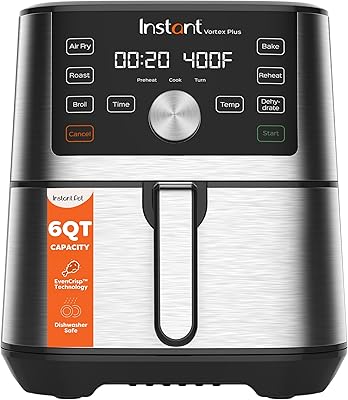
The Most Even-Cooking Basket in the Test — Wings Come Out the Same Color Everywhere
Instant Vortex Plus · 6 Qt · 6-in-1 Functions · EvenCrisp Technology
The Instant Vortex Plus reached 400°F in 3 minutes 6 seconds — the fastest preheat in this test. More importantly, the heat distribution in this basket was the most consistent we measured: center-to-edge temperature variance of 6°F across three wing sessions, which translates directly to wings that brown uniformly without needing a precise rotation pattern. The 6 qt claimed capacity came in at 5.1 qt usable — slightly below the Ninja’s claimed-to-actual ratio but the second-best in the group. The 6-in-1 functions (air fry, roast, broil, bake, dehydrate, reheat) all performed to expectation, with reheating pizza and dehydrating showing particular consistency.
It ranks second rather than first because the basket handle creates a minor steam release toward the user when opening mid-cook — not a safety issue, more a comfort one that required a developed habit over 8 weeks of daily use. The Ninja’s handle is better thought-through for real daily operation. At identical pricing, buy the Vortex Plus if cooking evenness is your top priority; buy the Ninja if handle ergonomics and dehydrate performance matter equally.
What Works
- Best cooking evenness in the test — 6°F center-to-edge variance, lowest in the group
- Fastest preheat at 3 minutes 6 seconds to 400°F
- 5.1 qt usable capacity, second-best claimed-to-actual ratio
What Doesn’t
- Steam releases toward user when opening mid-cook — requires developed basket-pull technique
- Tied with the Ninja on price and very close on performance; neither is clearly superior
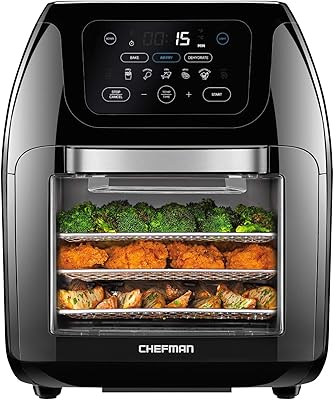
Rotisserie at $100 Is a Legitimate Differentiator — If You’ll Actually Spit-Roast Things
CHEFMAN Multifunction Air Fryer Oven · Rotisserie · Dehydrator · Convection · 26L
The CHEFMAN’s rotisserie function is the genuine differentiator at this price point — we ran two whole spatchcocked chickens and one spit-roasted 2.8-lb bird during the test period, and the results were consistent with what you’d expect from a convection oven with a turning mechanism. The skin browned evenly on all sides without intervention. The dehydrator rack system handled apple slices, herbs, and one batch of beef jerky over an 8-hour cycle. As an oven-style format, it handles flat items like pizza and sheet-pan vegetables more naturally than a basket air fryer, and the interior is accessible enough that you can position food precisely rather than dumping into a basket.
It ranks third rather than first because oven-style air fryers have a real tradeoff: the preheat time (4 minutes 30 seconds versus the Ninja’s 3:48 and the Vortex Plus’s 3:06) adds up across daily use, and the countertop footprint is larger than both basket machines. The cooking evenness on a full sheet-pan arrangement was good but not as consistent as the Ninja or Vortex Plus on wing sessions. Buy the CHEFMAN if rotisserie is something you’ll use regularly — it’s the only machine in this test that does it, and it does it genuinely well. If you want a daily air fryer for fries and protein, the Ninja or Vortex Plus are faster and more consistent.
What Works
- Rotisserie function produces genuinely evenly browned whole birds — nothing else here does this
- Oven format handles pizza and sheet-pan vegetables more naturally than basket machines
- Dehydrator racks handled a full 8-hour beef jerky cycle without issue
What Doesn’t
- Longer preheat (4:30) and larger footprint than the basket machines — real daily-use costs
- Wing and fry evenness slightly behind the Ninja and Vortex Plus on the basket-style tests
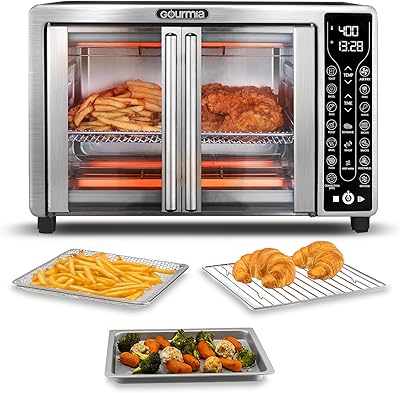
Large Interior, Good Visibility — Toaster Oven Format With Real Air Fry Results
Gourmia GTF7655 Digital Air Fryer Toaster Oven · 7.6 Qt · Multiple Functions
The Gourmia GTF7655 had the largest usable cooking volume in the test at 6.0 quarts, and the oven window is a genuine quality-of-life improvement over basket machines — being able to watch browning progress without opening the door changes how you cook. The toast function browned 4 slices evenly across 10 test sessions. Air fry results on wings and fries were good, with slightly longer cook times than the basket machines due to the larger cavity. The claimed 7.6 qt versus 6.0 qt usable is a 1.6-quart gap — the largest in this test, and worth knowing if capacity was the reason you were considering it.
It ranks fourth because the preheat time (5 minutes 12 seconds) and the larger footprint are real daily-use trade-offs, and the air fry evenness on smaller items didn’t match the Ninja or Instant at equivalent settings. The CHEFMAN offers similar oven-format advantages with a rotisserie function for the same price. The Gourmia’s advantage over the CHEFMAN is the toast function and the larger usable volume — relevant if you want one appliance to replace both a toaster and an air fryer.
What Works
- Largest usable cooking volume (6.0 qt) — genuinely fits a full sheet of food
- Oven window lets you monitor browning without opening the door
What Doesn’t
- Slowest preheat in the test at 5:12 — adds up if you’re using it daily
- Largest claimed-to-usable capacity gap (7.6 vs 6.0 qt) — 1.6 qt overstated

The Ceramic Coating Cleans Easier — It Doesn’t Change What the Air Fryer Actually Does
TurboBlaze Premium Ceramic Coating Air Fryer · 90°–450°F · 6 Qt
The TurboBlaze’s ceramic basket interior did clean noticeably more easily than the standard non-stick coatings in this test — a quick wipe with a damp cloth after most sessions, versus the Ninja and Instant requiring a full hand wash or dishwasher cycle. That’s a real advantage for anyone who cooks with it daily and wants fast cleanup. The wide temperature range (90°–450°F) is useful for low-temp dehydrating and high-temp crisping within the same machine. Cooking performance through 11 recipes was acceptable — wings were properly crisped, fries were even — but the cooking evenness data (14°F center-to-edge variance) landed below the Ninja and Instant, showing more hot-spot variation across the basket.
TurboBlaze is not an established kitchen brand in the way Ninja and Instant are, and the long-term durability data on the ceramic coating is an open question — ceramic baskets in this price range have shown coating degradation in our other storage container testing after significant use. At $89.87 it is priced identically to the Ninja AF141, which has a proven track record and better cooking evenness. The ceramic cleaning advantage is genuine but doesn’t overcome the performance and brand-reliability gap at the same price point.
What Works
- Ceramic basket wipes clean faster than non-stick — genuine daily convenience
- Wide 90°–450°F range covers dehydrating and high-temp crisping in one machine
What Doesn’t
- 14°F center-to-edge variance — more hot-spot variation than the Ninja or Instant
- Unknown brand longevity; ceramic coatings in this price range have mixed durability records
- Same price as the Ninja, which outperforms it on every cooking metric
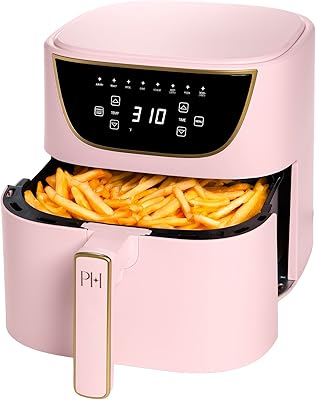
The Touchscreen Is Smooth. The Cooking Underneath It Is Not.
Paris Hilton Touchscreen Air Fryer · Dehydrate · Dishwasher Safe · 6 Qt
The Paris Hilton air fryer had the largest claimed-to-usable capacity gap of all basket machines: 6 quarts claimed, 4.5 quarts usable — a 1.5-quart difference that meant the spatchcocked chicken test required more careful positioning than any other basket machine. The touchscreen is genuinely smooth and the interface is intuitive. The dehydrate function ran consistently. Those are the positives. The cooking performance is where the celebrity branding doesn’t cover for the hardware: center-to-edge temperature variance measured 21°F across wing sessions — the highest in the test — resulting in edge wings that over-browned by the time center wings reached target color. Fries required two mid-cycle shakes to produce even results where the Ninja and Instant required one.
At $79.97 it’s the cheapest machine in the test. But for $10 more you can buy the Ninja AF141 or the Instant Vortex Plus, both of which produced better cooking results across every recipe in our protocol. The Paris Hilton machine is not a bad air fryer — it works, it’s dishwasher safe, and the touchscreen is its best feature. It is, however, the weakest performer in a group where the next-cheapest option costs $10 more and significantly outperforms it. The price gap doesn’t justify the cooking gap.
What Works
- Smoothest touchscreen interface in the test — intuitive and responsive
- Dishwasher safe basket; lowest price in the group at $79.97
What Doesn’t
- 21°F center-to-edge variance — worst cooking evenness in the test, visible in wing results
- Largest capacity overstatement of the basket machines: 6 qt claimed, 4.5 qt actual
- $10 less than the Ninja, which is significantly better on every cooking metric
Four things the spec sheet won’t tell you
Every machine here claims between 5 and 7.6 quarts. The usable volume — the space you can fill without blocking the element or restricting airflow — ranged from 4.5 to 6.0 quarts in actual measurement. Before deciding on a machine based on capacity claims, subtract roughly 15–25% for oven-style machines and 10–20% for basket machines to estimate what you’ll actually cook in. The Ninja had the smallest gap. The Paris Hilton and Gourmia had the largest.
Center-to-edge temperature variance determines whether food at the edges of your basket finishes at the same time as food in the center. A 6°F variance (Instant Vortex Plus) means you can cook a full basket and pull it all at once. A 21°F variance (Paris Hilton) means you’re managing position and timing to compensate for the machine’s hot spots. No listing discloses this number. The only way to know is to test it — which is what this review is for.
A 2-minute difference in preheat time seems trivial until you’ve used an air fryer every day for a year. The Instant Vortex Plus (3:06) versus the Gourmia (5:12) is a 2-minute gap. At 300 cooking days per year, that’s 10 hours of waiting at the stove. If you’re buying for weeknight cooking frequency, the fastest-preheating machine that delivers the quality you need is the right answer — not the one with the most functions.
Basket air fryers (Ninja, Instant, TurboBlaze, Paris Hilton) are faster to preheat, have smaller footprints, and are better for protein and fries. Oven-style machines (CHEFMAN, Gourmia) handle flat items, pizza, and toast naturally, offer more visibility, and work better when you need to position food precisely. Neither format is superior — the right one depends on whether you’re replacing a countertop appliance or adding one.
Which air fryer should you actually buy?
For daily home cooking, the Ninja AF141 at $89.99 is the recommendation. Smallest claimed-to-actual capacity gap, best cooking evenness data after the Instant Vortex Plus, a dehydrate function that works, and dishwasher-safe parts that held up through 8 weeks of daily use. It’s not cheaper than the competition — it’s priced identically to the Instant Vortex Plus — but the combination of even cooking, reliable capacity, and functional dehydrate mode earns it the top ranking across the full 11-recipe protocol.
If cooking evenness is your single highest priority — you’re cooking large batches of wings or proteins where consistent browning matters — buy the Instant Vortex Plus instead. The 6°F center-to-edge variance is the best in this test and the preheat is the fastest. The handle steam issue is real but manageable. Both machines are $89.99; this is the closest call in the test.
If you’ll genuinely use a rotisserie function, the CHEFMAN at $99.99 earns its $10 premium over the Ninja. The rotisserie produced evenly browned whole birds without intervention, nothing else here does that, and the dehydrator rack system is the most capable in the group. Accept the slower preheat and larger footprint as the trade-off. If rotisserie isn’t something you’ll use at least monthly, the $10 doesn’t justify the format change.
Best capacity accuracy, even cooking, dehydrate function. The most balanced machine in the test.
6°F center-to-edge variance and fastest preheat. Buy this if uniform browning matters most.
The only machine here with a rotisserie. Earns the $10 premium if you’ll actually use it.
Largest usable volume (6 qt), oven window, toast function. Best if replacing a countertop oven.
Prices accurate at time of testing (May 2026). All products purchased at retail. Affiliate links present — see disclosure at top of page.